Shikoku Temple 64, Maegamiji
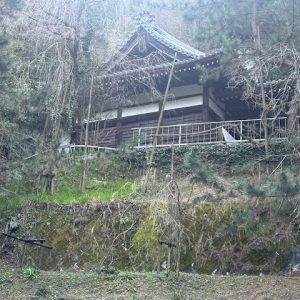
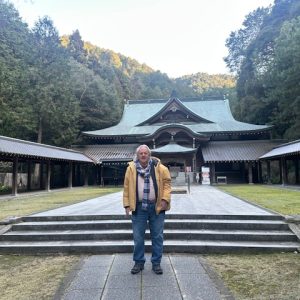
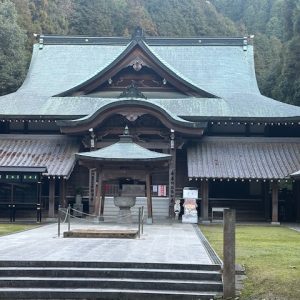
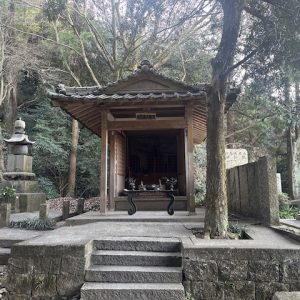
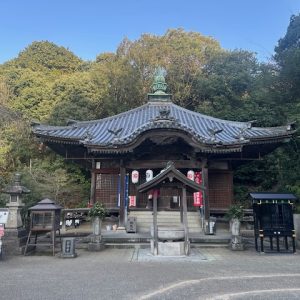
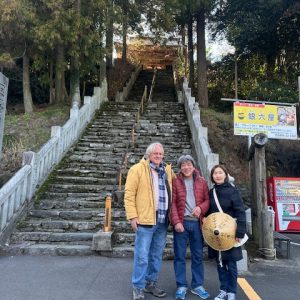
It is difficult to say something about every temple, because they are often very similar. But travelling from one to another, one can enter a Buddhist meditative dreamland.
Also, on this, my first trip around the Shikoku temples, I feel that I am barely scratching the surface. I’ll be back again next year.
Maegamiji is located at the foot of Mt. Ishizuchi (elevation 1982 m), one of the seven sacred mountains of Japan. It is the head temple of the Ishizuchi School of the Shingon Sect and the fundamental center of Shugendo.
The temple was founded during the reign of Emperor Temmu (673-686) by En no Gyoja Ozunu, the founder of Shugendo. Ozunu, who had trained himself on Mt. Ishizuchi, saw Shaka Nyorai and Amida Nyorai appear as the Great Gongen to relieve the suffering of mankind. He carved statues of them which he enshrined in the temple.
Emperor Kanmu (reigned 781-806) prayed to be healed from an illness, and his wish was granted. The emperor built seven main buildings and named the temple Konjikiin Maegamiji. Since then, the temple had been worshiped by many successive emperors including Emperor Montoku, Emperor Takakura, Emperor Go-Toba, and Emperor Juntoku. Kukai/Kobo Daishi later visited Mt. Ishizuchi twice, where he is known to have practiced the Kokuzo Gumonjiho and the Goma fire ritual, and also fasted.
During the Edo period (1603-1868), the temple became a temple of the Matsudaira family, the feudal lords of Saijo, Ehime, and the temple flourished, as evidenced by the conferral of the three-leaf hollyhock crest on the temple. However, due to the edicts ordering the separation of Shinto and Buddhism in 1868, the temple’s territory was confiscated and the temple was forced to close for a time. In 1889 the temple was restored, and it continues to pass on Buddhist teachings as the head temple of the Ishizuchi School of the Shingon Sect.
The annual Oyama-biraki (mountain opening) on July 1 is held at the temple, and believers dressed in white gather to chant “Nammai-da” to the accompaniment of blowing conch shells.