Temple 68, Jinnein, and Temple 69, Kannonji
Every serious pilgrim, like me, must carry his/her pilgrim stamp book and have it stamped at each temple — and pay 500 yen (about 5 dollars) for the stamp. Apparently these stamps are the main source of temple income.
Watching the calligrapher execute his work is a joy to watch, even if one does not understand. And as is often the case in Japan, there can be some traditional theatre.
I like to protograph the calligrapher, but some refuse to have their photo taken, while others will only accept a photo that excludes their face.
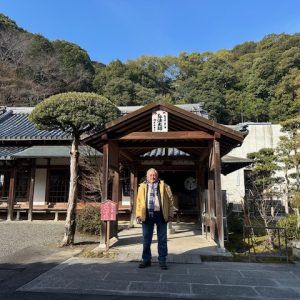
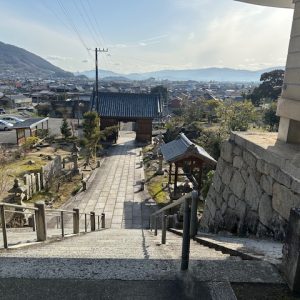
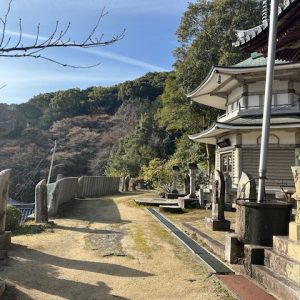
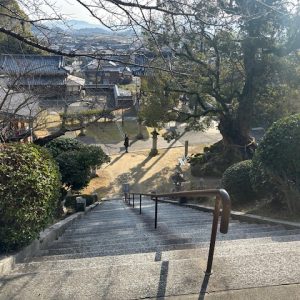
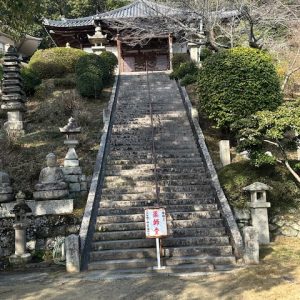
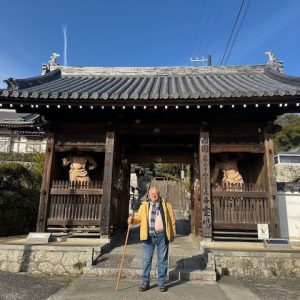
Anyway, on this pilgrimage I encountered two temples, Temple 68, Jinnein, and Temple 69, Kannonji, which are located side by side, halfway up Mt. Kotohiki, a small mountain in Kotohiki Park. They are the only pair of pilgrimage temples located together like this.
Jinnein was founded by Nissho Shonin, a high priest of the Hossō sect of Buddhism. He received an oracle from the Usa Hachimangu Shrine in 703 when he was practicing asceticism in this area. After discovering a sacred boat and a koto (a Japanese musical instrument resembling a harp), he built the Kotohiki Hachimangu Shrine at Mt. Kotohiki and enshrined the boat and the koto there.
Jinnein was built as a branch of this shrine. Kobo Daishi carved a statue of Amida Nyorai (Buddha of Limitless Light and Life) in 807, enshrined it as the principal image of the Kotohiki Hachimangu Shrine, and designated it as the 68th temple of the Shikoku Pilgrimage. Later he renamed the temple Jinnein (Temple of Divine Grace).
In 1868, Jinnein and the Kotohiki Hachimangu Shrine were separated under the edicts separating Buddhist and Shinto sites issued by the Meiji Government and Jinnein was moved to the premises of Kannonji.
At the same time, the statue of Amida Nyorai which had been enshrined in Kotohiki Hachimangu Shrine was moved to the Saikondo of Jinnein. The statue of Amida Nyorai became the principal image of the temple and the Saikondo (built in 2002) became its Hondo, while Jinnenin became the 68th sacred site of the Shikoku Pilgrimage. Previously the shrine had acted as the 68th site.