Baroque-Romanesque Philippine church
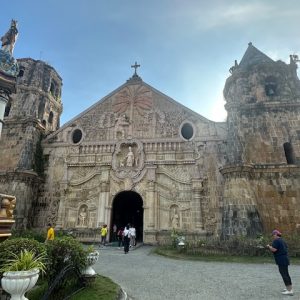
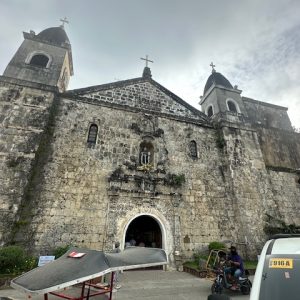
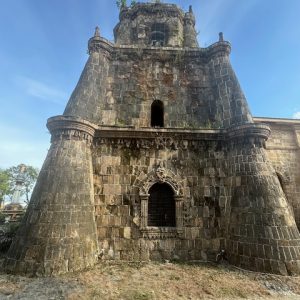

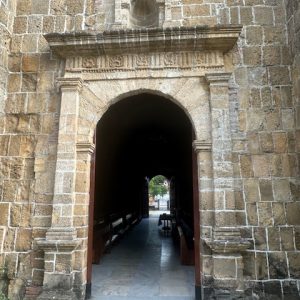
On a recent trip to Iloilo, I visited Santo Tomás de Villanueva Parish Church, commonly known as Miagao Church. It is a Roman Catholic church located in Miagao, Iloilo, Philippines. As you can see from the photos, the church has a stunning facade.
The church was declared as a UNESCO World Heritage Site on December 11, 1993, together with San Agustin Church in Manila; Nuestra Señora de la Asuncion Church in Santa Maria, Ilocos Sur; and San Agustin Church in Paoay, Ilocos Norte under the collective title Baroque Churches of the Philippines, a collection of four Baroque Spanish-era churches.
Miagao was formerly a visita (a locality served by a visiting priest) of Oton until 1580, Tigbauan until 1592, San Joaquín until 1703 and Guimbal until 1731. It became an independent parish of the Augustinians in 1731 under the advocacy of Saint Thomas of Villanova.
When the town experienced Moro invasions in 1741 and 1754, the town moved to a more secure place. From there, a new church was constructed in 1787 through forced labor under the supervision of Fray Francisco Gonzales, parish priest and Spanish gobernadorcillo Domingo Libo-on.
The church was severely damaged during the Spanish revolution in 1898 but was later rebuilt. It has also suffered from fire in 1910, the second World War and an earthquake in 1948. The present church is the third structure built since its establishment in 1731.
The church’s over-all architectural style falls under the Baroque-Romanesque style. Its ochre color is due to the materials used in constructing the church: adobe, egg, coral and limestone.
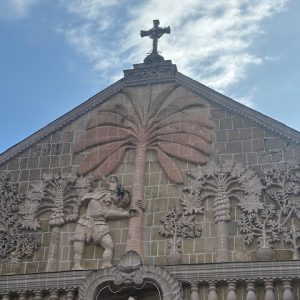
The façade of the church consists of an ornately decorated bas-relief in the middle of two huge watchtower belfries on each side. The bas-relief is a mixed influence of medieval Spanish, Chinese, Muslim and local traditions and elements, a unique characteristic of the church façade. A prominent part of the façade is a coconut tree depicted as the tree of life where St. Christopher holds on.
The Miagao Church is a must see in the Philippines